Cat Litter Box Certification Requirements for EU, UK and US Importers
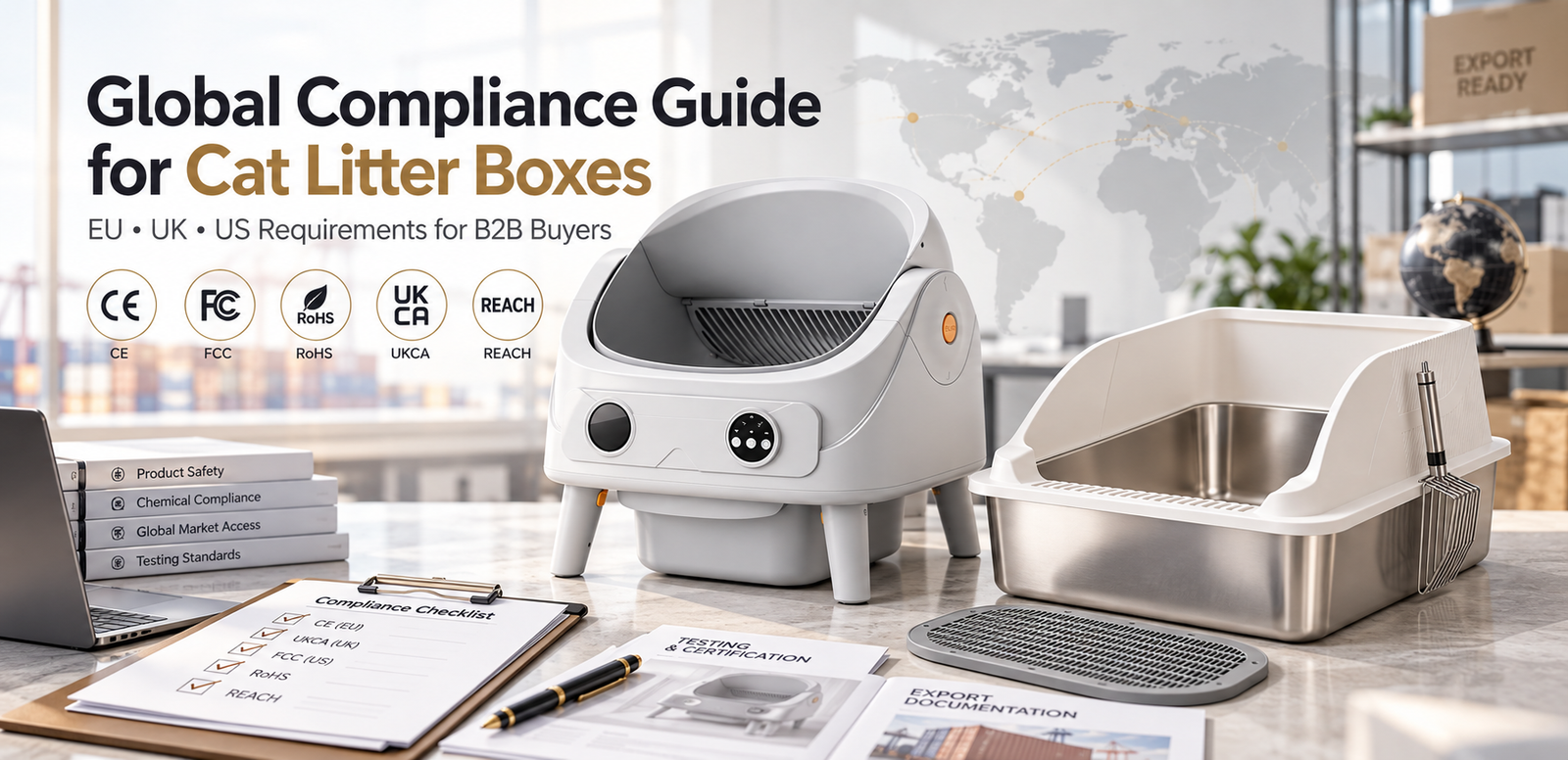
Cat litter box certification requirements vary by product type, electrical configuration and destination market. For importers, distributors, wholesalers and private-label pet brands, checking a supplier’s certification logos is not enough to establish that a product can legally be sold in the European Union, United Kingdom or United States.
A Wi-Fi enabled automatic cat litter box may be subject to radio equipment, electrical safety, electromagnetic compatibility, chemical substance and connected-device security requirements. A basic non-electrical stainless steel litter tray may follow a different product safety and materials compliance route.
This guide explains how B2B buyers can identify applicable requirements, request meaningful compliance documents and reduce the risk of ordering a product that is not ready for the intended market.
Regulatory overview reviewed for October 2026. Requirements and official guidance can change. This article provides procurement guidance rather than legal or certification advice; verify the exact final SKU with qualified compliance professionals and current market authorities.
1. Quick Answer: What Certifications Does a Cat Litter Box Need?
There is no universal certification package for every cat litter box. Buyers should first identify whether the finished product contains electrical equipment, radio transmitters, batteries or other regulated features.
| Market | Requirement to Evaluate | Typical Relevance |
|---|---|---|
| European Union | CE marking and applicable EU product legislation | Electrical, electronic or radio-enabled models when within scope |
| European Union | RoHS | Electrical and electronic equipment within scope |
| European Union | REACH | Relevant chemical restrictions and substance information duties for articles |
| European Union | GPSR and other product safety rules | Consumer product safety obligations, considering applicable sector-specific rules |
| European Union | WEEE obligations | Electrical and electronic equipment placed on relevant markets |
| Great Britain | Applicable UK product regulations, CE or UKCA marking as permitted | In-scope regulated products, depending on conformity route |
| United Kingdom | Connected product cybersecurity rules where applicable | Consumer smart products capable of connecting to networks |
| United States | FCC equipment authorization | Radiofrequency devices, including relevant Wi-Fi equipment |
| United States | Applicable product safety, chemical and state rules | Depends on product design, materials and intended market |
A compliance checklist should identify the exact applicable legal provisions, not simply repeat the words CE, FCC and RoHS from a catalogue.
2. CE Marking for Automatic Cat Litter Boxes in the European Union
CE marking indicates that a manufacturer declares conformity with applicable EU legislation requiring that mark. It is not a general quality award, and it does not mean a product has been approved by the European Union.
For a smart automatic cat litter box, relevant legal requirements may include the Radio Equipment Directive when the product incorporates Wi-Fi or Bluetooth, along with other legislation applicable to the final configuration.
The Radio Equipment Directive contains essential requirements covering radio spectrum use, safety and electromagnetic compatibility. Buyers should not automatically demand separate conformity declarations under every electrical directive without first identifying the applicable legal scope.
Before accepting a CE-marked product, request:
- The complete EU Declaration of Conformity for the exact product.
- The manufacturer’s legal name and contact information.
- Exact model number and product identification.
- Applicable EU directives or regulations.
- Referenced standards and conformity assessment route.
- Relevant test reports and supporting technical documentation.
- Product, rating-label and packaging photographs.
- Correct user instructions and safety information for the destination market.
Some conformity assessment routes allow manufacturer self-assessment; others may require involvement of a notified body. Verify which procedure applies to the actual product.
Official reference: European Commission guidance on CE marking.
3. EU Radio Equipment and Cybersecurity Requirements for Wi-Fi Cat Litter Boxes
A smart litter box with internet-connected radio functionality requires a more detailed assessment than a basic non-connected product.
Under EU radio equipment legislation, additional cybersecurity-related essential requirements became applicable to certain categories of radio equipment on 1 August 2025.
Depending on the product category and functionality, these requirements address matters such as network protection, personal data and privacy, and protection against fraud.
For a Wi-Fi enabled cat litter box, an importer should establish whether the finished equipment falls within the relevant scope and what conformity assessment and technical evidence are required.
Questions to Ask the Supplier
- Which radio module and firmware version are used in the final product?
- What wireless frequencies and functions are supported?
- Is the equipment covered by the relevant Radio Equipment Directive assessment?
- Has the manufacturer reviewed applicable connected-device cybersecurity requirements?
- Who maintains firmware and security updates?
- How are software vulnerabilities reported and addressed?
- Are there changes to the app, wireless module or firmware for the private-label version?
The EU Cyber Resilience Act introduces broader requirements for products with digital elements, with its main obligations becoming applicable in December 2027. Buyers planning long-term product programs should account for future compliance responsibilities and applicable transitional provisions.
4. RoHS Requirements for Electronic Cat Litter Boxes
RoHS stands for Restriction of Hazardous Substances. EU RoHS legislation restricts specified hazardous substances in electrical and electronic equipment within its scope.
For an automatic litter box containing electrical and electronic components, buyers should ask how RoHS conformity is demonstrated for the finished model and its materials or components.
Useful evidence may include:
- Applicable RoHS conformity declarations.
- Material declarations for relevant components.
- Risk-based testing documents where appropriate.
- Supplier control and material traceability records.
- Information about applicable exemptions.
- Change-control procedures for electronic components.
Do not assume a generic RoHS test report from an unrelated product proves conformity for a different finished SKU.
RoHS is also distinct from FCC authorization and CE marking under other legislation. These requirements cover different regulatory questions.
5. REACH Compliance for Cat Litter Box Materials and Components
REACH is the European Union’s framework for the registration, evaluation, authorization and restriction of chemicals.
Its relevant obligations can affect products and components beyond electrical appliances, including plastic housings, rubber parts, coatings, accessories and other materials used in cat litter boxes.
For article suppliers, information obligations may arise where substances on the REACH Candidate List are present above applicable thresholds. Separate restrictions or notification duties may also apply depending on the material and circumstances.
For a procurement review, ask:
- Which materials are used in the product and accessories?
- Can the supplier provide material declarations and relevant test reports?
- Have applicable REACH restrictions been evaluated?
- Are any Candidate List substances present above relevant thresholds?
- What substance information must be supplied to the importer or downstream business?
- How are material substitutions managed during mass production?
The European Chemicals Agency provides guidance on communication duties for Candidate List substances in articles.
Buyers should not treat a single generic “REACH certificate” as proof of compliance with all possible chemical requirements.
6. EU GPSR and General Product Safety Responsibilities
The EU General Product Safety Regulation, Regulation (EU) 2023/988, became applicable on 13 December 2024.
It establishes a general product safety framework for consumer products while interacting with relevant sector-specific safety legislation.
For importers and private-label brands, key topics to review include product safety risk assessment, traceability, instructions and warnings, economic operator information, online sales information and procedures for handling unsafe products.
When reviewing a cat litter box sourcing program, consider whether the product has:
- Identifiable manufacturer and relevant economic operator information.
- Model, batch or serial identification where required.
- Instructions and safety information appropriate for the destination.
- Documented risk analysis and supporting safety evidence.
- A process for customer complaints and safety incidents.
- A system for corrective actions, withdrawal or recall when necessary.
Official regulation: EU General Product Safety Regulation overview.
7. WEEE and Environmental Responsibilities for Smart Litter Boxes
For electrical and electronic cat litter boxes sold in the EU, WEEE obligations may include registration, reporting, financing waste treatment and other producer-responsibility arrangements.
These obligations are not satisfied merely by obtaining a RoHS declaration or applying a CE mark.
An importer should identify the responsible economic operator, the destination country and whether a national WEEE registration or compliance scheme is required.
Review the applicable labeling and product information requirements as well.
Official guidance: European Union WEEE responsibilities.
8. UKCA and CE Marking for Cat Litter Boxes Sold in Great Britain
Great Britain comprises England, Scotland and Wales. Its product conformity requirements should be distinguished from the arrangements that apply in Northern Ireland.
Under the United Kingdom’s continued recognition arrangements, CE marking remains accepted for many regulated product categories placed on the Great Britain market, subject to the applicable rules and conformity assessment conditions.
UKCA remains an available conformity marking route for relevant products.
For a radio-enabled smart litter box, buyers should review the applicable Great Britain Radio Equipment Regulations 2017 and any other relevant product requirements.
The correct marking depends on the applicable product legislation and how conformity has been assessed.
Do not automatically assume that every product entering Great Britain must carry UKCA instead of CE, or that an EU conformity document alone fulfills every UK obligation.
Official guidance: UK Radio Equipment Regulations — Great Britain.
9. UK Smart Product Security Requirements
The United Kingdom introduced its consumer connectable product security regime on 29 April 2024 under the Product Security and Telecommunications Infrastructure framework.
For products within scope, the regime includes requirements addressing product passwords, security issue reporting and information about minimum security update periods.
Importers and distributors have responsibilities alongside manufacturers.
For connected cat litter boxes intended for UK consumers, ask the supplier to clarify:
- Whether the model falls within the relevant connected-product scope.
- How password requirements are satisfied.
- Where users can report security vulnerabilities.
- The published minimum security update period.
- Who maintains the product’s software and connected services.
- Whether the required statement of compliance and supporting information are available.
Distinct Northern Ireland arrangements and applicable exclusions must be checked separately.
Official reference: UK consumer connectable product security regulations.
10. Northern Ireland Is Not the Same as Great Britain
Buyers supplying Northern Ireland should not automatically apply Great Britain marking rules.
Under the relevant arrangements, Northern Ireland continues to follow applicable EU-aligned product rules for covered goods. CE marking remains important, and CE plus UKNI marking can be required in particular conformity assessment situations.
The UKNI marking is not a standalone replacement for CE marking and cannot be used to place products on the EU market in the same way as CE-only products.
Confirm the final destination and conformity assessment route before printing labels or approving branded packaging.
Official guidance: Placing CE or CE and UKNI marked products on the Northern Ireland market.
11. FCC Requirements for Automatic Litter Boxes in the United States
The United States Federal Communications Commission regulates radiofrequency devices under applicable equipment authorization rules.
A Wi-Fi enabled automatic litter box commonly includes an intentional radiofrequency transmitter. The relevant radio equipment generally requires FCC certification unless a specific rule or exemption provides otherwise.
Other digital electronic functions may be subject to Supplier’s Declaration of Conformity or other applicable authorization requirements.
FCC authorization is not an all-purpose product safety certificate. It addresses the equipment’s applicable radiofrequency regulatory obligations.
Documents to Request for a US Wholesale Order
- FCC ID where certification is required.
- Identification of the approved wireless module.
- Applicable test reports and grant information.
- Final product label and required user information.
- Information about module integration and installation conditions.
- Confirmation of relevant authorization for the final product configuration.
- Responsible party information when required.
An FCC-certified module does not automatically establish full compliance of every host product in which it is installed.
Changes to radio hardware, antennas or other relevant design elements may create additional evaluation or authorization obligations.
Official FCC reference: 47 CFR Section 15.201 — Equipment Authorization Requirement.
12. US Product Safety and Chemical Compliance Beyond FCC
FCC authorization should not be confused with electrical safety, mechanical safety or chemical compliance.
Depending on the finished product and market, US buyers may need to review applicable federal and state requirements, product warnings, materials, electrical safety evaluation and other sector-specific obligations.
Relevant chemical rules can include provisions under the Toxic Substances Control Act (TSCA), where applicable to materials or finished articles.
For products sold in California, buyers may also need to evaluate relevant state-level warning and chemical requirements.
Do not assume every automatic or stainless steel litter box requires the same testing program.
Ask a qualified US compliance specialist to map requirements to the actual finished model, intended users and states of sale.
Reference: US EPA information on TSCA restrictions for certain substances.
13. Automatic vs Stainless Steel Cat Litter Box Compliance
The distinction between electronic and non-electronic products is important for supplier evaluation.
| Compliance Area | Automatic Smart Litter Box | Non-Electrical Stainless Steel Litter Box |
|---|---|---|
| Electrical and electronic requirements | Evaluate applicable requirements | Generally not applicable without electrical functions |
| Radio equipment rules | Relevant when Wi-Fi, Bluetooth or another radio transmitter is included | Generally not applicable without radio functions |
| Material and chemical restrictions | Evaluate relevant materials and components | Evaluate relevant materials, coatings and accessories |
| Mechanical product safety | Relevant to moving parts, access and product structure | Relevant to edges, stability and product construction |
| Traceability and labeling | Check market-specific obligations | Check market-specific obligations |
| Connected-device cybersecurity | Evaluate when relevant connected functions are included | Not normally applicable to a basic non-connected tray |
For stainless steel products, verify any claimed material grade such as SUS304 separately from the legal requirements applicable to the finished consumer product.
Not every non-electrical metal litter tray needs CE or FCC authorization. Suppliers should not apply these marks to products outside the scope of the relevant marking legislation.
14. The Seven-Document Compliance Checklist for B2B Buyers
Before confirming a bulk order, request a model-specific compliance file.
Depending on the destination and product, the following seven document categories provide a useful starting point:
- Product Identification: Exact model, hardware revision, photographs and technical specification.
- Applicable Legislation Matrix: Written assessment of the requirements relevant to the destination.
- Conformity Declarations: Applicable EU, UK or other declarations and supporting identification.
- Testing Evidence: Reports for electrical, wireless, material or product safety matters where applicable.
- Labeling and Manuals: Final product label, packaging artwork and required safety information.
- Importer and Manufacturer Information: Names, addresses and responsible economic operators as required.
- Change-Control Records: Identification of approved components, firmware, packaging and product revisions.
Some markets or products require additional documents or registrations. The purpose of this checklist is to reveal gaps before the shipment is released.
15. How to Verify Supplier Test Reports and Certification Claims
A PDF report is meaningful only when it corresponds to the actual product and relevant requirement.
Buyers should inspect the following details:
- Does the manufacturer or applicant name match the business information?
- Does the model number match the product being purchased?
- Does the tested product image resemble the final configuration?
- Are the standards, test conditions and dates identifiable?
- Is the laboratory or conformity assessment body appropriate for the claimed scope?
- Are required declarations properly issued and signed?
- Does a wireless module change affect the existing evidence?
- Can the supplier explain what the report covers and what it does not cover?
Where relevant, independently verify certification identifiers or grants using the responsible authority’s official records.
Warning sign: A supplier offers one certificate containing many regulatory logos but cannot provide model-specific evidence or a legally appropriate conformity declaration.
16. OEM/ODM Changes Can Affect Product Compliance
Private-label cat litter box programs can range from light branding to engineering modifications.
Simple logo or carton artwork changes may primarily affect identification, instructions, economic operator roles and labeling obligations. Deeper changes can require additional technical review.
Examples include:
- Replacing a Wi-Fi or Bluetooth module.
- Changing the power adapter or electrical configuration.
- Modifying motor controls or protective sensors.
- Changing the housing or accessibility of moving components.
- Replacing important materials.
- Introducing a new app or firmware version.
- Changing accessories or product packaging in ways affecting safety or compliance.
A brand owner placing a product on the market under its own name may assume manufacturer responsibilities under relevant legislation.
Before approving an OEM/ODM project, agree on who will manage the required testing, declarations, technical files and labeling.
Review YOUNIHAO OEM/ODM customization information and request a project-specific compliance assessment.
17. Compliance RFQ Template for Cat Litter Box Importers
Use the following message when requesting documentation from a potential supplier:
We are evaluating cat litter boxes for import into [EU country / Great Britain / Northern Ireland / United States].
Our preferred product is [automatic Wi-Fi litter box / non-connected automatic model / stainless steel litter box], with an estimated first-order quantity of [quantity] units.
Please provide the exact model specifications, applicable market compliance requirements, available declarations of conformity, test reports, FCC ID where relevant, material compliance information, product labeling, manuals and manufacturer details.
Please also identify any compliance changes required for our private-label branding, packaging, app configuration or other requested modifications.
Confirm which documents are currently available, which additional tests may be needed, the responsible parties and estimated completion schedule before mass production.
Buyers should request documents early enough to resolve gaps before approving custom packaging and large-volume production.
Frequently Asked Questions About Cat Litter Box Certifications
Does Every Automatic Cat Litter Box Need CE Marking?
CE marking is required only when the product falls within EU legislation mandating it. Many electrical or radio-enabled automatic litter boxes are likely to fall within applicable EU conformity requirements, but the exact legal route depends on the final configuration.
Is CE Marking the Same as a CE Certificate?
No. CE marking represents the manufacturer’s conformity declaration under applicable legislation. The required conformity assessment may involve self-assessment or an independent notified body, depending on the product and legal requirements.
Does a Wi-Fi Cat Litter Box Need FCC Certification in the United States?
A Wi-Fi transmitter generally falls under applicable FCC intentional-radiator rules, which commonly require equipment certification. Confirm the specific equipment authorization, module integration conditions and finished-product requirements.
Is UKCA Mandatory for All Products Sold in Britain?
No. Great Britain continues to recognize CE marking for many product categories subject to applicable conditions. UKCA remains a relevant option. Determine the permitted route for the exact product and market.
Does an Ordinary Stainless Steel Cat Litter Box Require FCC Approval?
A basic non-electrical tray without radiofrequency functions would not normally fall within FCC radio equipment authorization requirements. Other product safety, chemical or labeling obligations may still apply.
Are RoHS and REACH the Same?
No. RoHS addresses specified hazardous substances in electrical and electronic equipment within its scope. REACH regulates chemicals and creates relevant restrictions and information duties across a wider range of substances and products.
Can a Private-Label Brand Use the Factory’s Existing Test Reports?
Existing reports may support the assessment when the tested configuration and documentation are relevant. However, brand ownership, modifications, market rules and responsible-party obligations must be reviewed. The use of an existing report does not automatically remove the private-label brand’s legal responsibilities.
What Documents Should I Request Before Ordering Smart Litter Boxes for Europe?
Start with exact product identification, the applicable EU Declaration of Conformity, relevant technical and testing information, instructions, labeling, traceability details and the responsible economic operator information. Assess chemical, environmental and connected-device obligations separately where relevant.
Build a More Compliant Global Cat Litter Box Supply Program
Successful international sourcing requires more than competitive pricing or a list of certification logos.
Importers, distributors and private-label pet brands should verify the final product configuration, destination-market requirements, supplier documentation and approval responsibilities before committing to bulk production.
YOUNIHAO presents automatic and stainless steel cat litter box product lines for international B2B sourcing discussions, including OEM/ODM customization and product documentation coordination.
Explore the YOUNIHAO Cat Litter Box Product Collection or contact YOUNIHAO to request a model-specific quotation and available compliance documentation.
For an efficient discussion, share your company name, destination country, preferred model, expected quantity and required customization.
Disclaimer: This article is for general product sourcing and regulatory awareness. It is not a substitute for professional legal, testing or conformity assessment advice. Requirements should be reconfirmed before placing each finished product on its destination market.

OEM · ODM · Private Label
Ready to Source Your
Next Cat Litter Box?
Low MOQ. CE, RoHS & EMC certified. Custom packaging and accessories available. Trusted by brands across Europe and North America.
Uncategorized
Cat Litter Box Packaging and Shipping: A Landed Cost Guide for Importers
Cat litter box shi...
Uncategorized
How to Audit a Cat Litter Box Factory: Quality Control Checklist for B2B Buyers
A cat litter box f...

Uncategorized
Stainless Steel Cat Litter Box Wholesale: SUS304 Buying Guide for B2B Buyers
Stainless steel ca...