
How to Audit a Cat Litter Box Factory: Quality Control Checklist for B2B Buyers
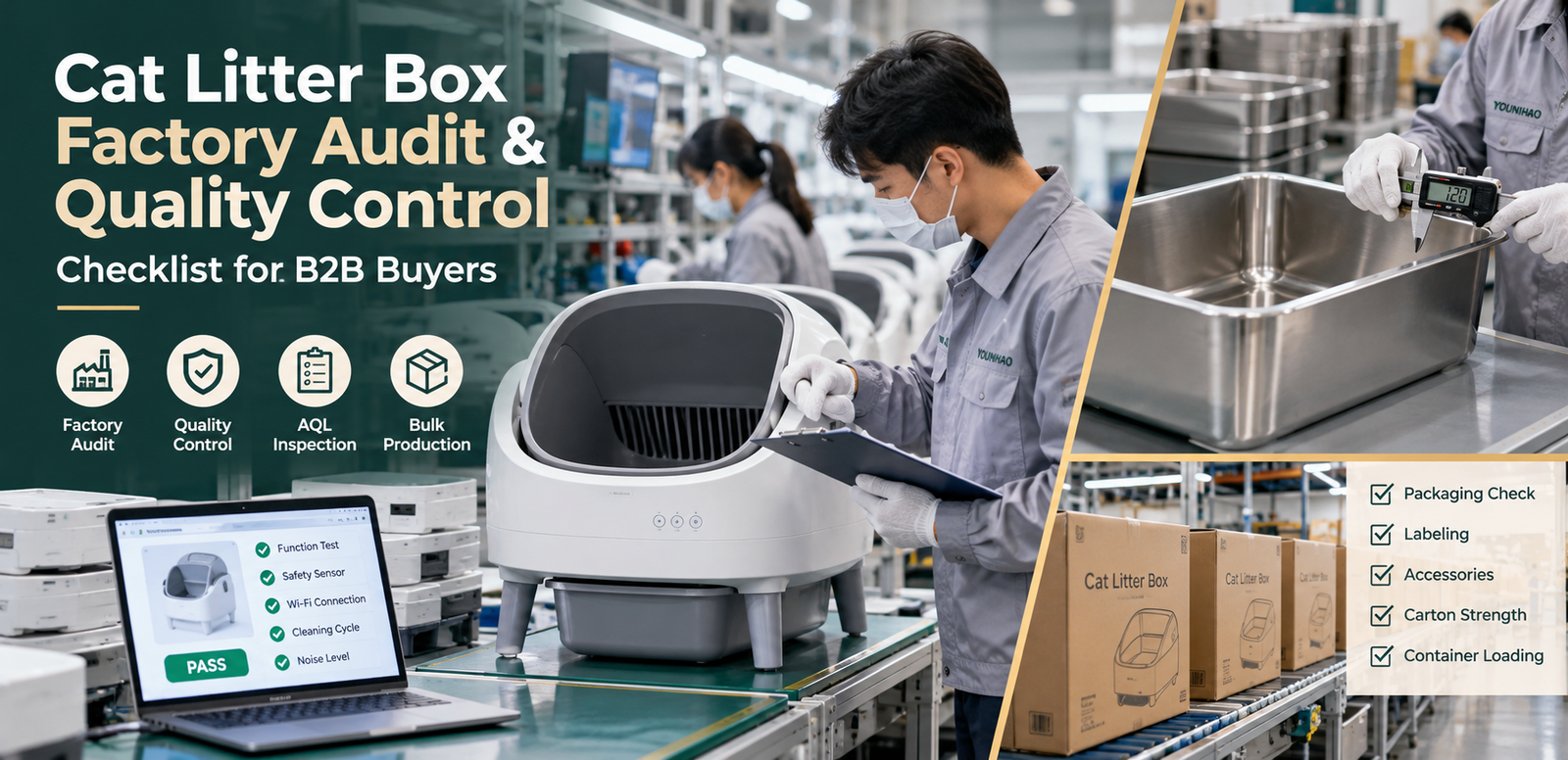
A cat litter box factory audit should answer one commercial question: can this supplier deliver the approved product consistently, at the agreed quality level, across repeat B2B orders? A clean showroom and an attractive product sample are useful starting points, but they cannot replace verification of production processes, testing records, material controls, traceability and corrective actions.
This cat litter box factory audit checklist is designed for importers, distributors, private-label pet brands, wholesale buyers and sourcing managers evaluating manufacturers of automatic self-cleaning litter boxes and stainless steel litter trays. It explains what to ask, what evidence to request and how to connect an initial supplier audit with a reliable bulk-order quality plan.
1. Factory Audit vs Product Inspection: What Is the Difference?
A factory audit reviews the supplier’s manufacturing system, resources and ability to control processes. A product inspection checks a defined batch of materials, in-process products or finished goods against agreed acceptance criteria.
Both matter: a good management system does not guarantee that one shipment is perfect, and one passing shipment does not prove that the factory can repeat its performance.
| Activity | Primary Question | Evidence to Request |
|---|---|---|
| Supplier Verification | Who is legally and operationally responsible for production? | Company details, site address, business documents and production scope. |
| Factory Audit | Can the process produce the same approved result consistently? | Process flow, staff roles, equipment, control plans, training and records. |
| During-Production Inspection | Are active orders being manufactured according to specification? | In-process measurements, test results and defect correction records. |
| Pre-Shipment Inspection | Does the packed lot meet the approved purchase specification? | Sampling plan, inspection report, photos and release decision. |
2. Verify the Factory Identity and Manufacturing Scope
Before discussing price or visiting a production line, confirm who owns the purchase contract, which site makes the product, whether production steps are subcontracted and who is responsible for final inspection.
A trading company can be a valuable supply-chain partner, but buyers should distinguish its role from the actual manufacturing site.
- Legal business name and site address match the documents and proposed agreement.
- Product scope includes the exact automatic or stainless steel litter box types you plan to purchase.
- Major operations performed in-house versus outsourced are clearly identified.
- Quality, engineering, production and after-sales contacts have defined responsibilities.
- The factory can provide model-specific drawings, bills of materials and approved sample references.
Red flag: A supplier refuses to identify the actual production location or cannot connect the offered model to a manufacturing and inspection record.
3. Review Production Capacity Without Relying on Marketing Numbers
Factory size, worker count and production-line numbers can be useful context, but B2B buyers should ask about realistic output for the exact SKU.
Verify the practical bottleneck: assembly, molding, stainless steel forming, electronic board supply, functional testing, aging space or final packing.
Request a production-flow chart, example order schedule and evidence of how the facility manages peak periods, material shortages and rework.
For a launch program, clarify pilot production, tooling readiness, capacity reservation, change-control deadlines and the definition of the production lead-time start date.
4. Audit Incoming Quality Control and Material Traceability
Incoming Quality Control, commonly called IQC, starts with approved supplier lists and material specifications.
The auditor should check whether important components are identified, accepted or rejected against documented criteria before entering production.
Smart Litter Box Components
- Weight sensors and infrared sensors
- Motor assemblies and moving components
- Power adapters and wiring assemblies
- Electronic control boards
- Plastic housings and structural parts
- Wi-Fi modules where applicable
Stainless Steel Litter Box Components
- Specified stainless steel grade
- Sheet thickness and dimensional tolerance
- Formed stainless steel trays
- Protective shields and sidewalls
- Fasteners and accessories
- Surface-finishing materials
Packaging and Supporting Materials
- Retail cartons
- Outer shipping cartons
- Product labels and barcodes
- User manuals
- Protective packaging materials
- Accessories and replacement parts
Ask how material lot numbers link to finished production batches.
If a component fails, the supplier should be able to identify which products may be affected and what corrective action follows.
5. Automatic Cat Litter Box Quality Control Checklist
Automatic cat litter box quality control requires more than a demonstration of one normal cleaning cycle.
The inspection plan should address electronics, mechanical movement, sensor response, assembly and customer setup.
| Checkpoint | Buyer Questions and Test Expectations |
|---|---|
| Power and Startup | Does the unit power on correctly with the intended adapter and market configuration? |
| Cleaning Mechanism | Are complete cycles repeatable? What happens after interruption or loss of power? |
| Safety Sensing | What conditions are detected and how does the mechanism stop or restart? Ask for test procedures and records. |
| Motor and Moving Parts | Are abnormal noises, rubbing, overheating and unexpected movement investigated? |
| App and Wi-Fi | Can a test account pair successfully? Are supported functions, firmware version and reset behavior recorded? |
| Waste Container | Do bins, liners, access panels and seals fit the approved model? |
| Assembly and Appearance | Are gaps, fasteners, scratches, sharp edges and cosmetic defects within approved limits? |
| Packaging and Labeling | Are the plug, manual, accessories, model labels and carton contents correct for the destination? |
Where a supplier reports a 100% functional test, request its written definition.
Ask which operations are covered, how failures are captured, how repaired units are retested and whether records are maintained by lot or serial number.
A 100% check of certain functions is not the same as a guarantee that every possible defect has been eliminated.
6. Stainless Steel Cat Litter Box Inspection Checklist
For a non-electronic stainless steel litter tray, inspection should focus on the material, forming quality, dimensions, finish, fit and transport protection.
Do not copy the electrical testing requirements of smart litter boxes into an unrelated non-powered product.
- Material: Specified grade, supported traceability and agreed verification method for any SUS304 claim.
- Thickness: Measured sheet thickness and approved tolerance.
- Dimensions: Overall length, width, height, usable internal space and entry height.
- Edges: Burr removal, rolled edges and safe handling surfaces.
- Appearance: Approved limits for scratches, dents, deformation and finish differences.
- Components: Lid or shield fit, scoop, sifting insert and feet when applicable.
- Packaging: Protection against movement, abrasion, dents and carton damage.
A premium surface can look excellent in sample photography but still fail commercially if trays scratch during nesting or shipping.
Request validation using the actual approved retail packaging.
7. Evaluate IPQC, Functional Testing and Reliability Evidence
In-Process Quality Control (IPQC) helps identify problems before completed units are boxed.
Ask which production stations have checks, which parameters are recorded, how nonconforming material is separated and who can authorize a restart after a failed test.
For electronic models, reliability or aging tests may be appropriate, but the auditor should review specific conditions, sample quantities, test duration, acceptance rules and follow-up actions.
A display claiming “aging tested” without a documented method is insufficient evidence for a purchasing decision.
Check calibration records for relevant measurement tools and ask how assembly staff receive updated instructions after a product design or component change.
8. Use an Agreed AQL Sampling Plan

OEM · ODM · Private Label
Ready to Source Your
Next Cat Litter Box?
Low MOQ. CE, RoHS & EMC certified. Custom packaging and accessories available. Trusted by brands across Europe and North America.
Uncategorized
Cat Litter Box Certification Requirements for EU, UK and US Importers
Cat litter box cer...
Uncategorized
Cat Litter Box Packaging and Shipping: A Landed Cost Guide for Importers
Cat litter box shi...

Uncategorized
Stainless Steel Cat Litter Box Wholesale: SUS304 Buying Guide for B2B Buyers
Stainless steel ca...