Automatic Cat Litter Box Wholesale: A Buying Guide for Distributors and Pet Brands
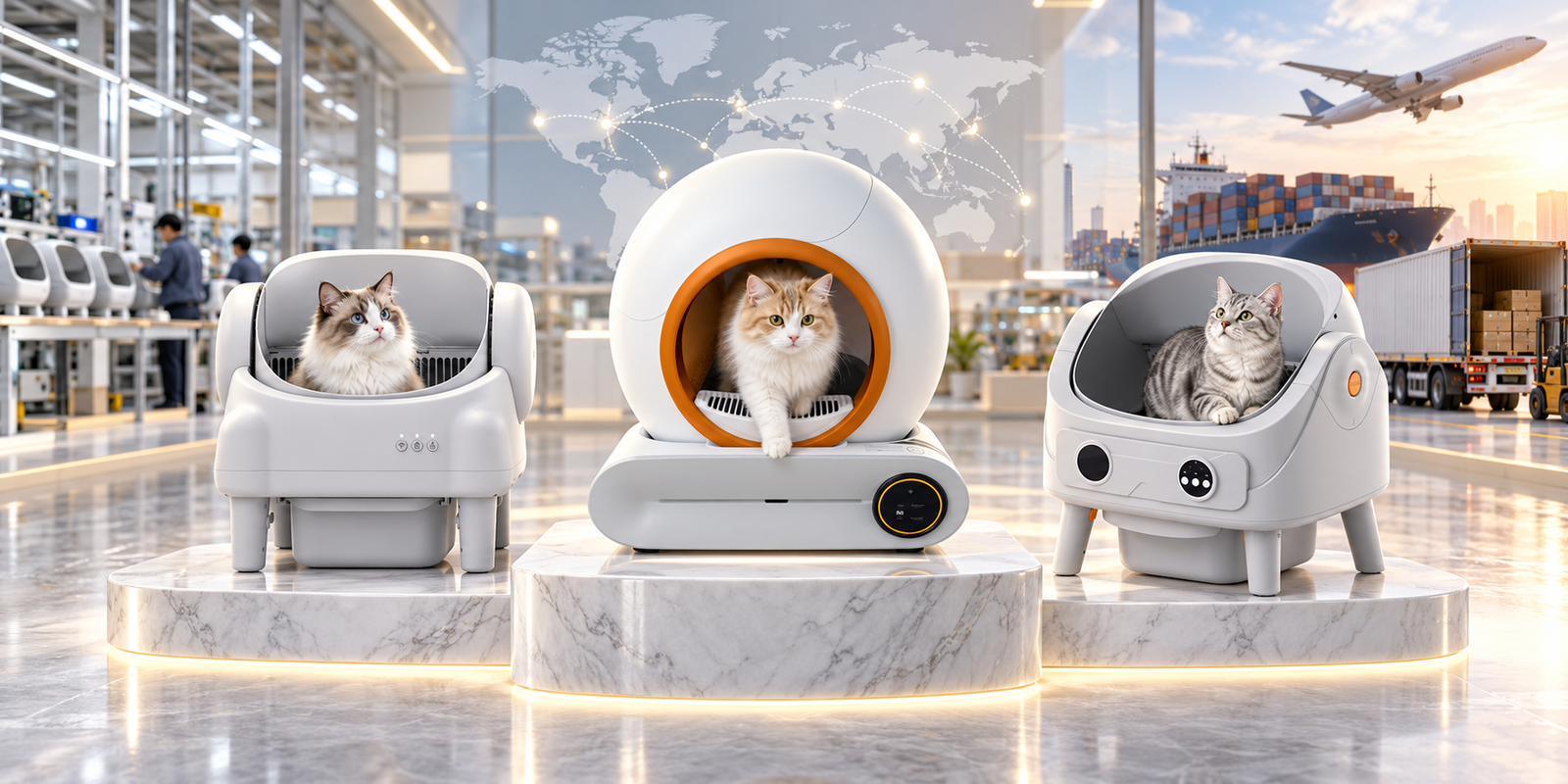
For wholesalers and distributors, an automatic cat litter box is not simply an electronic pet product. It is a combination of hardware, user experience, firmware or app support, after-sales obligations and a repeatable supply program. Buying decisions should therefore start with the sales channel and target market, not the lowest quoted unit price.
This guide explains how importers, retail chains, private-label pet brands and e-commerce purchasing teams can compare self-cleaning cat litter box suppliers and prepare a more useful bulk-order inquiry.
1. Define the sales channel before selecting a smart litter box
A distributor serving specialist pet stores may prioritize demonstration quality, retailer training and spare parts. An Amazon-oriented brand may focus on packaging resilience, customer troubleshooting, replacement components and review risk. A regional importer may require multilingual instructions, multiple plug configurations and consistent reorder supply.
- Importers: documentation, destination-market suitability, shipping volume and landed cost.
- Distributors: channel pricing, model continuity, replacement parts and after-sales support.
- Private-label brands: differentiated appearance, logo, packaging, onboarding material and consistent quality.
- Retail buyers: shelf positioning, product demonstrations, carton protection and returns handling.
2. Open-top versus enclosed automatic cat litter boxes
Both formats can fit a premium pet-care assortment, but they answer different positioning questions. An open-top automatic litter box emphasizes straightforward access and visible use. Enclosed units may appeal to shoppers looking for a more contained appearance. Neither format should be presented as universally better for every cat or household.
| Buyer consideration | Open-top design | Enclosed design |
|---|---|---|
| Merchandising story | Easy-access, open design | Contained, furniture-friendly silhouette |
| Product demonstration | Cleaning mechanism may be easier to observe | Explain the entrance and internal mechanism clearly |
| Customer guidance | Check access dimensions and footprint | Check entrance dimensions and interior space |
| Supplier evaluation | Ask about exposed moving parts and sensors | Ask about door/entry safety and internal access |
Request current model drawings and measured specifications rather than relying solely on marketing photography.
3. Compare the complete feature system
App connectivity and software responsibility
If a model supports Wi-Fi or a Tuya-based app configuration, confirm the exact connected functions, supported wireless frequency, app language coverage, account setup, privacy materials and whether the configuration will remain available for repeat orders. Ask who maintains firmware, manages app updates and responds when customers cannot connect their device.
Self-cleaning mechanics and safety
Review cleaning-cycle triggers, sensing methods, moving-part protection, power interruption behavior and the procedure for testing those features. Ask to see a sample demonstrating abnormal conditions, not just a successful cleaning cycle. Verify any weight-range or noise-level claim on the particular SKU being quoted.
Cleaning, waste bin and replacement parts
Compare the waste-collection capacity, removable components, cleaning instructions, compatible liners if applicable and replaceable parts. A spare-part catalogue and troubleshooting guide can reduce post-sale friction for a growing wholesale program.
4. Ask for a model-specific supplier data pack
A useful automatic cat litter box manufacturer should help buyers evaluate the exact SKU under discussion. Request:
- Specification sheet, material composition, dimensions, weight and available colors.
- Product and package photos, carton dimensions and packing configuration.
- Instruction manual and supported destination languages.
- Demonstration video for normal operation and safety-related behavior.
- Applicable conformity documents linked to the precise model and market.
- Sample policy, lead time, bulk MOQ, production scheduling and warranty terms.
- Spare parts, defect handling and software or app-support arrangements.
5. Separate standard wholesale orders from OEM/ODM projects
A standard model with existing packaging may be easier to trial than a customized version. OEM work can involve branded cartons, logo application, colors, manuals or accessory kits; ODM work may require engineering evaluation, new tooling or additional testing. Each change should be priced and approved separately.
Use a version-controlled requirement sheet listing artwork approval, product configuration, sample reference, production tolerance and who owns any custom tooling or creative files. For more detail, see YOUNIHAO’s OEM/ODM manufacturing information.
6. Calculate bulk-order economics beyond unit price
Compare supplier quotes using the same Incoterm, payment basis, packing method and estimated quantity. A low EXW price is not directly comparable with a FOB quote that includes different local charges. Add sample testing, custom packaging, spare parts, freight, customs duties, taxes, warehousing and expected returns to the buyer’s landed-cost model.
Before committing to a large purchase, confirm whether samples represent the final shipping configuration and whether the confirmed production lead time begins after deposit, final artwork approval, sample sign-off or another milestone.
7. A practical RFQ template for a smart cat litter box supplier
We are sourcing automatic self-cleaning cat litter boxes for [country/market] and sell through [distribution/retail/e-commerce]. Please quote [open-top/enclosed model] at [quantity] units, with [standard/private-label] packaging. Confirm current specifications, app support, safety testing, model-specific compliance documents, MOQ, sample policy, estimated lead time, carton dimensions, spare-parts support and EXW/FOB terms.
Frequently asked questions from B2B buyers
What is the MOQ for automatic cat litter box wholesale?
MOQ is model- and configuration-dependent. Standard wholesale, custom logo, custom packaging and new tooling may carry different thresholds. Ask for a written quantity breakdown instead of assuming one MOQ applies to every project.
Can an app-controlled cat litter box be private labeled?
Selected models may support branding and packaging customization. Software branding or deeper app changes should be scoped separately because technical feasibility, development effort and compliance may differ from simple logo application.
What should distributors test first?
Test cleaning behavior, sensor response, Wi-Fi setup where applicable, waste removal, noise, assembly, instructions and fault recovery. Record results against an approved sample before releasing the bulk order.
How should a buyer compare two quotes?
Normalize SKU configuration, requested quantity, packaging, trade term, sample scope, inspection criteria and after-sales obligations. The cheapest unit price may not produce the lowest total cost of ownership.
Build a scalable automatic litter box assortment
For a wholesale buyer, the best supplier conversation starts with market requirements and a documented sample plan. Explore YOUNIHAO’s cat litter box product collection, then request a B2B quotation with your target market, estimated quantity and preferred product type.

OEM · ODM · Private Label
Ready to Source Your
Next Cat Litter Box?
Low MOQ. CE, RoHS & EMC certified. Custom packaging and accessories available. Trusted by brands across Europe and North America.
Uncategorized
Cat Litter Box Certification Requirements for EU, UK and US Importers
Cat litter box cer...
Uncategorized
Cat Litter Box Packaging and Shipping: A Landed Cost Guide for Importers
Cat litter box shi...
Uncategorized
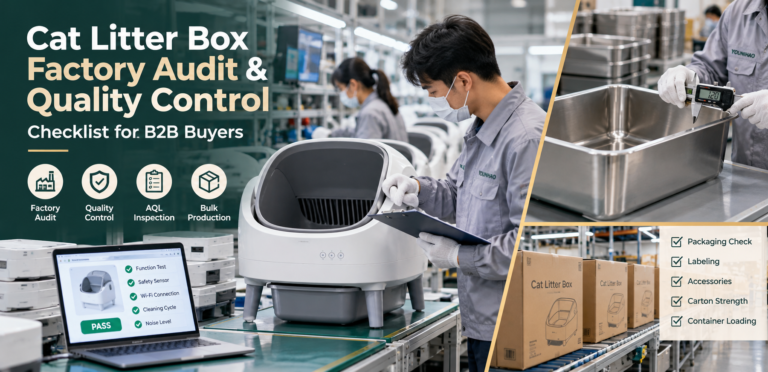
How to Audit a Cat Litter Box Factory: Quality Control Checklist for B2B Buyers
A cat litter box f...