Private Label Cat Litter Box Manufacturer: OEM vs ODM Guide for Pet Brands
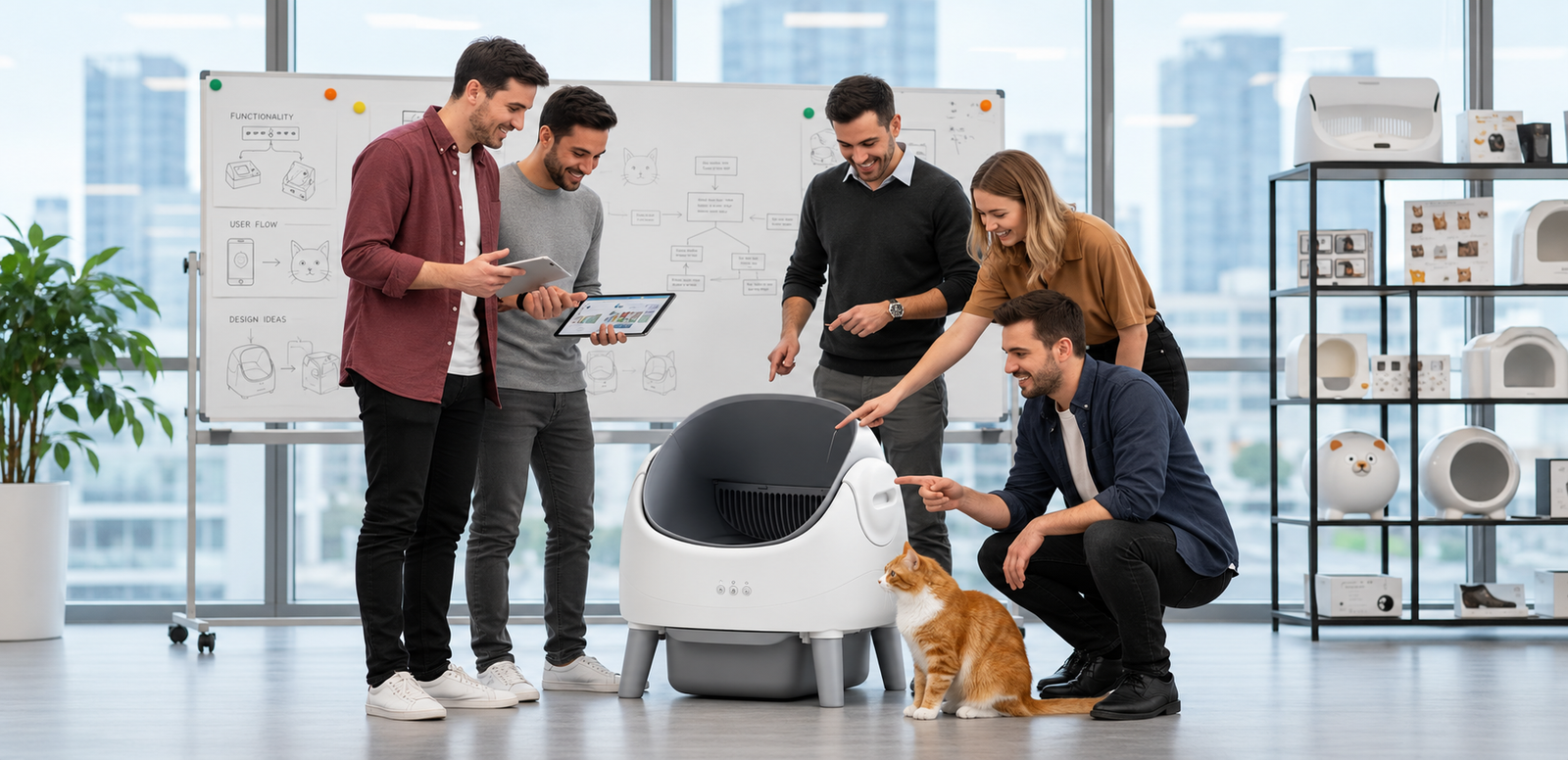
Private-label cat litter box manufacturing is a product-development process, not just a logo-printing request. A successful pet brand must connect product selection, brand design, packaging, instructions, compliance, sample approvals and repeat-order quality. These requirements become more complex when a smart automatic litter box includes electronics or connected features.
When evaluating a private label cat litter box manufacturer, ask which changes are supported by an existing model and which require design review, new parts or additional compliance work.
This guide is written for brand owners, product managers, importers and sourcing professionals deciding whether to launch with a ready-made model or commission deeper OEM/ODM development.
1. What Is the Difference Between OEM and ODM Cat Litter Boxes?
In everyday sourcing discussions, OEM often means applying agreed branding or configuration changes to an existing manufacturer model. ODM generally involves more product design or engineering input, potentially including a new structure, mold or customized functional design. Suppliers may use these terms differently, so the scope must be written down.
| Project Route | Typical Scope | Main Approval Items |
|---|---|---|
| Standard Wholesale | Existing product and packaging | Model, sample, price, carton and delivery |
| Light OEM | Logo, carton artwork, manuals or color | Brand assets, printing proof, reference sample |
| Advanced OEM | Component selection, accessory kits or market configuration | Technical specification and compliance review |
| ODM | New industrial design, mold or engineered features | Tooling, development milestones, testing and IP terms |
2. Choose a Product Platform That Fits Your Pet Brand
Automatic self-cleaning products can support technology-led positioning, while stainless steel litter boxes may support a durable, easy-care or premium-material proposition.
Choose the product platform based on shopper demand, target retail price, competitive assortment, expected support cost and destination-market requirements.
Start with the current YOUNIHAO cat litter box assortment and ask which existing models best fit the brand brief. A stable base model can reduce unnecessary development work, while a genuinely differentiated product may justify an ODM evaluation.
3. Create an OEM/ODM Requirement Brief
Send a concise project brief before requesting a fixed price. Useful inputs include:
- Country, buyer entity and intended sales channels.
- Target consumer and competitive retail positioning.
- Preferred litter box structure and approximate dimensions.
- Target annual forecast and first-order quantity.
- Brand logo format, color codes and packaging dielines.
- Language, voltage, plug, wireless or app requirements where relevant.
- Desired warranty handling and spare-parts policy.
- Required milestones: sample, artwork sign-off, pilot batch and launch.
Clearly label which elements are mandatory and which are negotiable. That distinction helps engineering and purchasing teams offer workable alternatives.
4. Custom Logo, Color, Packaging and User Manuals
Brand assets are production inputs. Custom logo application depends on surface finish, part geometry and printing method. Packaging depends on physical carton dimensions, artwork files, labeling rules and retail-channel handling requirements.
Multilingual instruction manuals may require technical proofreading rather than direct machine translation alone.
Ask the supplier for a physical or production-equivalent approval sample. Save the artwork revision number, approved color reference and photographs of the final placement.
Never assume a digital mockup guarantees an identical result on mass-produced parts.
5. ODM Engineering, Mold Development and Ownership
For structural changes or a new mold, require a separate development agreement describing feasibility reviews, drawings, tooling cost, payment milestones, rework responsibility, tolerance requirements, design ownership, exclusive-use arrangements if any, maintenance and storage of the tooling.
New structures can also affect packaging, drop protection, material selection, assembly and applicable conformity assessment.
Budget for the validation work before promising a launch date.
6. Smart Litter Box OEM Projects Require a Software Checklist
For app-enabled automatic litter boxes, confirm exactly what is included in the brand program.
A customized printed logo is not the same as a white-label app. Questions should cover app provider, supported features, languages, onboarding, device pairing, data handling, firmware updates and the escalation path for connectivity complaints.
If a project requests app or hardware modification, ask whether earlier test reports still cover the resulting model.
This should be decided before bulk production, not after cartons are printed.
7. Approve the Right Samples in the Right Order
- Commercial sample: Verify basic suitability and target positioning.
- Engineering or branded sample: Approve structure, functionality and custom elements.
- Pre-production reference: Establish what the factory will reproduce and inspect.
- Production validation: Compare final units, cartons and manuals to the signed reference.
Not every light customization needs all four physical stages, but every program should have an unambiguous final approval record.
8. Discuss MOQ, Price Breaks and Repeat Orders as One Program
Request quantity-based pricing for the same specification, but keep separate line items for tools, sample development, print plates, artwork services, test reports, replacement parts and export packing.
A project with an attractive first-order MOQ may still be costly if artwork or packaging changes must be repeated every batch.
Ask which parts and branded materials can remain stable for future orders. Agree on how design changes will be requested after launch and how legacy spare parts will be supported.
9. Private Label Cat Litter Box Supplier Evaluation Checklist
- Is the existing product platform proven and properly documented?
- Can the supplier explain the boundary between OEM and ODM?
- Are sampling and bulk quantities stated separately?
- Are tooling and intellectual property terms written into the contract?
- Is there a controlled approval process for packaging and manuals?
- Can the supplier offer inspection and after-sales arrangements?
- Do certificates and reports cover the final branded configuration?
10. Match Compliance to the Destination Market and Final Configuration
Private-label projects shipped to the EU, UK, US or other destinations may have different electrical, radio, chemical, labeling and documentation requirements.
Do not assume that a report for an unmodified base product automatically covers a new wireless module, power supply, housing, firmware or branded configuration.
Before production, ask which party acts as manufacturer, importer or responsible economic operator under the relevant rules, who holds technical documents and who approves product and packaging labels.
Confirm compliance against the actual final SKU and destination, not a generic certification badge.
11. How to Request a Private Label Cat Litter Box Quotation
A structured RFQ helps buyers compare offers from different manufacturers using the same requirements.
We are developing a private-label cat litter box range for [target country] under [brand name]. Our preferred product type is [automatic open-top / enclosed automatic / stainless steel] for [retail / distributor / e-commerce] sales.
Please provide standard and custom configurations, first-order MOQ, price breaks for [quantities], logo and packaging options, sample cost, development or tooling charges, target-market compliance documents, production lead time, quality inspection scope, spare-parts terms and EXW/FOB prices.
Our target launch date is [date].
Attach packaging references, logo artwork, color requirements and any must-have features.
Request a written change-control process so product, packaging and software revisions do not drift between the approved sample and the final batch.
Frequently Asked Questions About Private Label Cat Litter Box Manufacturing
Can I Put My Logo on an Automatic Cat Litter Box?
Selected models may allow logo and packaging customization. The method, placement, minimum quantity and artwork approval depend on the model and project.
Does Private Label Always Require a New Mold?
No. Many brand programs begin with existing models and customized presentation. New tooling becomes relevant when the design or physical structure requires it.
Who Owns ODM Tooling and Design Files?
Ownership should be specified in the commercial agreement. Do not infer ownership from payment alone; define access rights, maintenance and exclusivity clearly.
Can a Branded Product Use Existing Certifications?
Possibly, but not automatically. The final configuration, legal entity roles, labels and market requirements must be reviewed for applicable conformity obligations.
What Is the Minimum Order Quantity for Private-Label Cat Litter Boxes?
There is no universal MOQ. Logo application, customized cartons, color changes and a new mold can each have different quantity requirements. Ask for a project-specific MOQ and price-break quotation.
How Long Does an OEM or ODM Cat Litter Box Project Take?
Timing depends on whether you are customizing an existing model or developing tooling and functions. Separate sample and approval milestones from the confirmed mass production schedule, and account for testing or certification work where required.
Start Your Private Label Cat Litter Box Project With YOUNIHAO
YOUNIHAO discusses OEM/ODM projects across automatic and stainless steel litter box product lines.
Review our OEM/ODM manufacturing services to explore branding, packaging and customization possibilities for your target market.
Ready to develop a branded pet product range?
Contact YOUNIHAO for an OEM/ODM quotation →
Please include your company name, destination market, preferred product, estimated order quantity and customization requirements.

OEM · ODM · Private Label
Ready to Source Your
Next Cat Litter Box?
Low MOQ. CE, RoHS & EMC certified. Custom packaging and accessories available. Trusted by brands across Europe and North America.
Uncategorized
Cat Litter Box Certification Requirements for EU, UK and US Importers
Cat litter box cer...
Uncategorized
Cat Litter Box Packaging and Shipping: A Landed Cost Guide for Importers
Cat litter box shi...
Uncategorized
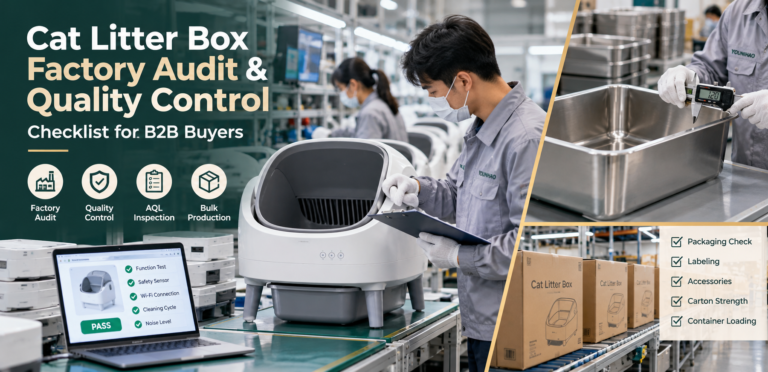
How to Audit a Cat Litter Box Factory: Quality Control Checklist for B2B Buyers
A cat litter box f...